
ChatGPT ads are becoming one of the most interesting topics for digital marketers in 2026.
For years, businesses have mainly relied on Google Ads, Meta Ads and other traditional advertising channels. Now, people are also using AI to research products, compare services and decide what to buy.
That creates a new question for marketers:
Can businesses advertise inside ChatGPT?
The answer is yes, although access depends on the market. OpenAI has been gradually expanding ChatGPT Ads, and its current Ads Manager availability page lists India as “Coming Soon” for self-service access.
In this guide, we’ll explain how ads in ChatGPT work, what ChatGPT Ads Manager is, how much advertising may cost, how it compares with Google and Meta, and what Indian businesses should know before getting started.
What Are ChatGPT Ads?
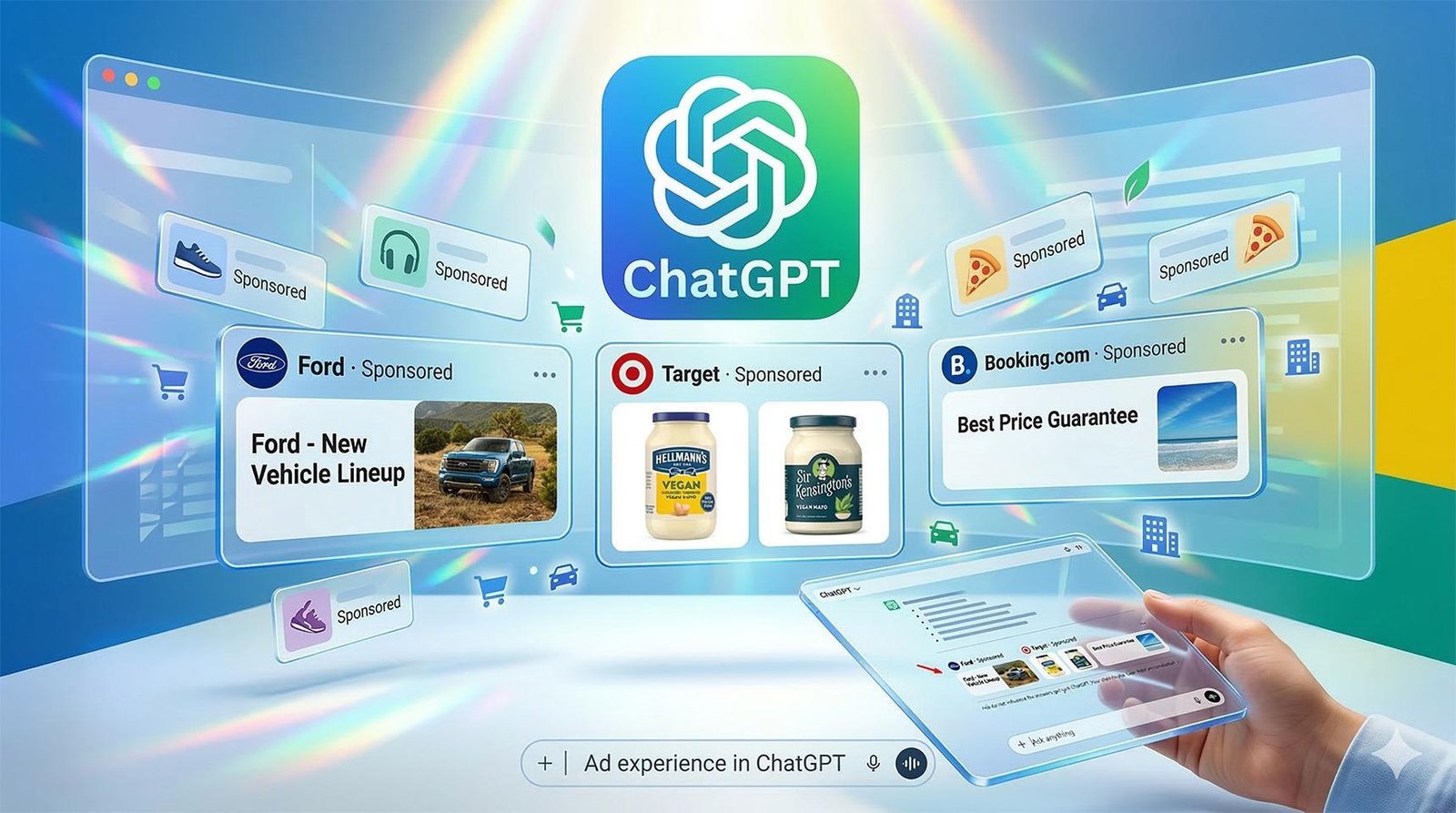
ChatGPT ads are sponsored advertisements that can appear within the ChatGPT experience.
The main difference is the environment in which the advertisement appears.
Google is built around search. Facebook and Instagram are built around social feeds. ChatGPT is built around conversations.
A person might tell ChatGPT exactly what they need instead of typing a short keyword.
For example:
“I want to buy a laptop under ₹80,000 for video editing. Which options should I consider?”
That conversation gives much more context than simply searching for “best laptop under ₹80,000.”
OpenAI says its advertising system is designed to help businesses reach people while they explore options, compare choices and make decisions in ChatGPT.
What does “ads in ChatGPT” mean?
Simply put, ads in ChatGPT means sponsored content displayed within the ChatGPT experience.
The ads are labelled as sponsored and are kept separate from ChatGPT’s organic answers.
This distinction matters because OpenAI says advertisers cannot pay to influence or change ChatGPT’s answers.
Are There Ads in ChatGPT in India?
This is where things have changed quickly.
OpenAI has been rolling out ChatGPT Ads market by market. Its official Ads Manager availability page currently lists India as “Coming Soon” for self-service access.
So Indian businesses should be careful with websites or agencies claiming that anyone can immediately open a standard self-service ChatGPT Ads Manager account from India.
The official availability can change as OpenAI expands the platform.
Who can see ChatGPT ads?
OpenAI says ads may appear for eligible logged-in adult users on the Free and Go plans.
Plus, Pro, Business, Enterprise and Edu accounts do not have ads. Accounts identified as belonging to users under 18 are also excluded.
Is ChatGPT advertising available to Indian businesses?
Self-service Ads Manager access is currently listed as Coming Soon for India.
OpenAI says advertisers in countries without self-service availability can still sign up and receive updates when access becomes available. Larger advertisers can also contact OpenAI’s Ads team about sales support.
Quick update for Indian marketers:
India is on OpenAI’s Ads Manager rollout list, but self-service access is not currently available. Check the official availability page before planning a campaign.
How Do ChatGPT Ads Work?
ChatGPT advertising is different from traditional keyword advertising.
When someone uses ChatGPT, they can provide a lot of information in one conversation.
For example:
Traditional search
best office space Gurgaon
AI conversation
I need an office in Gurgaon for 20 employees. I want good connectivity, parking and modern amenities. My budget is around ₹1 crore.
The second example gives the advertising system much more context about what the person is trying to achieve.
OpenAI describes this as going beyond keywords by using richer conversational context.
Where do ChatGPT ads appear?
OpenAI’s advertising model places sponsored content separately from the main ChatGPT answer.
The advertisement is clearly labelled so users can distinguish it from the AI-generated response.
Do ads influence ChatGPT answers?
No.
This is one of OpenAI’s key advertising principles.
The company says advertisements do not influence the answers ChatGPT provides. Advertisers cannot pay to make ChatGPT recommend their product in its organic response.
What about user privacy?
OpenAI says advertisers don’t receive users’ private chats, chat history, memories or personal details.
Advertisers receive aggregated information about advertising performance rather than individual conversations.
How ChatGPT Ads Work


Simple ChatGPT advertising flow
User asks a question
↓
ChatGPT understands the conversation
↓
Relevant advertising opportunity is identified
↓
Sponsored ad is displayed separately
↓
User clicks the advertisement
↓
Business landing page
↓
Lead / sale / conversion
The important difference is that the process starts with a conversation, not just a keyword.
What Is ChatGPT Ads Manager?
If you’ve used Meta Ads Manager or Google Ads, the idea behind ChatGPT Ads Manager will feel familiar.
OpenAI’s Ads Manager allows advertisers to create and manage campaigns directly.
OpenAI introduced a beta self-service Ads Manager in May 2026. Businesses can use it to create an advertiser account, add payment information, set budgets and bids, upload ads, launch campaigns and view performance.
What can advertisers manage?
Depending on availability and account access, advertisers can work with:
- Campaigns
- Ad groups
- Ads
- Budgets
- Bids
- Creative
- Landing pages
- Performance data
- Conversion measurement
OpenAI has also expanded its advertising platform beyond the original CPM model, adding CPC bidding and additional measurement capabilities.
ChatGPT Ads Manager vs Meta Ads Manager
| Feature | ChatGPT Ads | Meta Ads |
|---|---|---|
| Main environment | AI conversation | Social platforms |
| User behaviour | Research & decision-making | Discovery & engagement |
| Targeting approach | Context and audience signals | Audience & behavioural signals |
| Main platforms | ChatGPT | Facebook, Instagram |
| Best opportunity | High-intent research | Demand generation |
This doesn’t mean one platform will replace the other.
For many businesses, they may work better together.
ChatGPT Ads vs Google Ads
Google Ads is still one of the strongest platforms for capturing existing search demand.
Someone searching:
“Buy running shoes online”
already has a clear intention.
ChatGPT is different because the user may be at an earlier or deeper research stage.
For example:
“I run five days a week and need running shoes for long-distance training. Which type should I buy?”
This is where conversational advertising becomes interesting.
The simple difference
Google Ads:
Search → Ad → Website
ChatGPT Ads:
Conversation → Context → Sponsored Ad → Website
Neither approach is automatically better.
The right choice depends on your audience and business model.
ChatGPT Ads vs Meta Ads
Meta is excellent for discovering audiences and generating demand.
For example, an Indian real estate company might use Instagram Reels and Facebook ads to show premium office spaces to business owners and investors.
ChatGPT could play a different role.
A person might already be researching:
“Is buying commercial office space in Gurgaon a good investment?”
That person is much closer to a decision than someone casually scrolling Instagram.
This is why marketers should think about customer intent, not simply platform popularity.
ChatGPT Ads vs Claude AI
Claude AI is another major AI assistant, so it is natural for marketers to compare the two.
But businesses should not ask only:
“Which AI is better?”
The better question is:
“Where are my customers, and where can I actually advertise?”
ChatGPT currently has an expanding advertising ecosystem and an Ads Manager platform. OpenAI has also announced agency and technology partners to support advertising.
For marketers, the important comparison points are:
- Audience size
- Advertising availability
- Targeting
- Cost
- Measurement
- Conversion quality
- Business results
Benefits of ChatGPT Ads for Indian Businesses

1. Reach people during research
People often use ChatGPT when they are trying to understand something before making a decision.
That can create an attractive environment for advertisers.
2. Go beyond traditional keywords
A conversation can contain much more information than a two- or three-word search.
This gives businesses another way to think about relevance.
3. A new acquisition channel
Google and Meta aren’t going anywhere.
But ChatGPT could become another channel that marketers test alongside existing campaigns.
4. Potential for high-intent traffic
Someone actively comparing products or services may be more valuable than someone who simply sees an advertisement while scrolling.
The real test, however, is conversion performance.
How Much Do ChatGPT Ads Cost?
This is one area where marketers should avoid relying on random numbers found online.
OpenAI has expanded buying options beyond its original CPM model and introduced CPC bidding. It has also been developing conversion optimization and additional measurement tools.
Your actual advertising cost can depend on factors such as:
- Campaign objective
- Bid
- Competition
- Audience
- Context
- Ad relevance
- Campaign performance
CPC vs CPM
CPC — Cost Per Click
You pay based on clicks.
CPM — Cost Per Thousand Impressions
You pay based on impressions.
For a performance marketer, CPC is often easier to connect to traffic and lead-generation analysis.
But don’t judge a campaign only by CPC.
A ₹100 click that never converts isn’t necessarily better than a ₹300 click that produces a qualified customer.
How to Get Started With ChatGPT Advertising
If you’re an Indian business owner or marketer, now is a good time to prepare rather than rush.
Step 1: Check availability
India is currently listed as Coming Soon for self-service Ads Manager access.
Step 2: Define your goal
Decide what you actually want:
- Website traffic
- Leads
- Sales
- App installs
- Sign-ups
- Brand awareness
Step 3: Prepare your ads
Your ad should quickly explain:
What are you offering?
Who is it for?
Why should someone care?
Step 4: Prepare your landing page
Don’t send paid traffic to a confusing homepage.
Create a landing page that matches the message in your advertisement.
Step 5: Set up measurement
Use proper analytics and conversion tracking so you know whether your campaigns are generating real business results.
OpenAI has been expanding measurement capabilities, including its OpenAI Pixel and Conversions API.
Step 6: Start small
When access becomes available, don’t immediately move your entire advertising budget to ChatGPT.
Test.
Measure.
Learn.
Then scale what works.
ChatGPT Ads: Quick Comparison
| Factor | ChatGPT Ads | Google Ads | Meta Ads |
|---|---|---|---|
| User intent | High during research | High during search | Varies |
| Main experience | Conversation | Search | Social |
| Keyword dependence | Lower | High | Low |
| Discovery | Strong potential | Moderate | Strong |
| Lead generation | Potentially strong | Strong | Strong |
| Platform maturity | New | Mature | Mature |
The takeaway: ChatGPT Ads should be viewed as a new channel, not an automatic replacement for Google or Meta.
Challenges You Should Know About
ChatGPT advertising is still developing.
The biggest challenge for Indian advertisers right now is access.
OpenAI currently lists India as Coming Soon for self-service Ads Manager.
There are also advertising policies around sensitive and unsafe contexts. OpenAI says ads should not appear in contexts where they could undermine user trust or create brand-safety problems.
Another challenge is competition.
As more advertisers enter AI advertising, businesses will need better creative, stronger offers and better landing pages to stand out.
The Future of ChatGPT Ads in India
AI is changing how people discover information.
The old journey was often:
Google → Websites → Compare → Buy
The new journey can look more like:
Ask AI → Discuss options → Compare → Decide → Buy
That change could be important for marketers.
OpenAI says it plans to continue developing its advertising platform with additional formats, objectives, buying models and measurement capabilities.
For Indian businesses, the opportunity is worth watching closely.
But the smartest approach is simple:
Don’t chase the hype. Test the channel when you have access, measure the results, and scale only when it makes business sense.